
How many oceans are there really? Uncovering an amazing truth


Discovering the mysterious seascapes of our planet
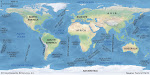
This map shows the world with its continents and oceans. Continents are marked with different colors, and oceans are blue. The map also shows some of the most important geographical features, such as mountain ranges, rivers and trenches.

Our planet, a fascinating tapestry of land and water, is home to vast expanses of ocean that have fascinated explorers and scientists for centuries. We are often taught that there are four different oceans that grace our globe : Pacific, Atlantic, Indian and Arctic. However, this perception soon takes an intriguing turn as we delve into the fascinating realm of maritime geography.

Discovery of the Fifth Ocean: Southern Ocean

For decades, the existence of the fifth ocean remained a subject of debate among oceanologists. However, in 2000, the International Hydrographic Organization (IHO) officially recognized the Southern Ocean as the fifth major ocean surrounding Antarctica. This decision became a key moment in our understanding of the oceanic divisions of the Earth.

Studying the unique characteristics of each ocean

Each of the five oceans has its own characteristics that distinguish it from its aquatic counterparts. Let's go on a journey to discover the fascinating characteristics of each ocean:

1. Pacific Ocean: The largest and deepest ocean covering nearly one-third of the Earth's surface, the Pacific Ocean is home to the giants of the sea, from colossal blue whales to adorable manta rays.

2. Atlantic Ocean: The second largest ocean, the Atlantic is a dynamic crossroads of global currents that plays a critical role in regulating Earth's climate. Its depths are home to a variety of marine life, including vibrant coral reefs teeming with colorful fish.

3. Indian Ocean: The third largest ocean, the Indian Ocean is known for its rich biodiversity, with many unique marine species including the majestic whale shark and the elusive nautilus.

4. Arctic Ocean: The smallest and shallowest ocean, the Arctic is an icy wonderland, the surface of which is permanently covered with ice almost all year round. Despite the harsh conditions, it supports a unique ecosystem adapted to extreme cold.

5. Southern Ocean: The Southern Ocean surrounding Antarctica is a stormy and cold realm characterized by powerful currents and icebergs. It plays an important role in regulating Earth's climate and is home to a variety of cold-adapted marine life, including penguins and seals.

Delving into many seas

Although the oceans dominate the world's water, they are not alone. Numerous seas are scattered throughout the globe, each with its own unique character and charm. These smaller bodies of water, often connected to oceans, are home to a variety of marine ecosystems and play a critical role in coastal environments.

A world of water wonders awaits

The oceans and seas of our planet are not just vast expanses of water; they teem with life, mystery and beauty. Every ocean and sea has its own fascinating story waiting to be revealed. As we continue to explore the depths of our watery kingdom, we discover new wonders and deepen our understanding of the interconnectedness of life on Earth.

Comments

IN TREND

Green Energy Costs to 2035: Prices & Trends

Green Energy Costs to 2035: Why Solar and Wind May Rise While Batteries Fall The global renewable energy revolution is accelerating. Governments, corporations, and households are investing billions in green energy systems. Yet a paradox is emerging: while the cost of generating solar power and wind energy may increase in the coming decade, battery storage prices are projected to decline significantly. Why is this happening? And what will it mean for consumers and investors by 2035? This evergreen analysis explores the economic forces shaping energy markets, provides price forecasts in U.S. dollars, and explains how global trends could redefine the cost of clean electricity. Why Green Energy Became So Affordable Over the past 15 years, renewable technologies have experienced dramatic cost reductions. According to the International Renewable Energy Agency (IRENA) , global weighted-average costs of solar photovoltaic electricity dropped by nearly 90% between 2010 an...

NASA’s Webb Uncovers Methane on Interstellar Comet 3I/ATLAS: A Cosmic Breakthrough

Imagine looking up at the night sky and realizing that the tiny, distant glimmer you see isn't just a remnant of our own cosmic neighborhood, but a visitor from a completely different solar system. The universe is whispering secrets to us, and for the first time in human history, we have the ears to listen. The James Webb Space Telescope (JWST) has just shattered our understanding of interstellar travelers by detecting methane on the comet 3I/ATLAS. This isn't just a chemical reading; it is a profound connection to the unknown, a bridge built of stardust and science that links our home to the mysterious voids between stars. The Arrival of an Interstellar Messenger For decades, astronomers dreamed of catching a glimpse of an object originating from outside our solar system. In 2017, we met 'Oumuamua, and later, 2I/Borisov. However, the discovery of 3I/ATLAS —often referred to as an interstellar comet—has provided us with a laboratory like no other. When this icy wanderer...

Top 10 Most Endangered Animals in the World (2025 Update)

Updated in 2025: Habitat destruction, climate change, and poaching are pushing countless species toward extinction. Here are the 10 most endangered animals in the world right now – and how we can still help save them. Sources: IUCN Red List, WWF, National Geographic, Wildlife Conservation Society 🦍 1. Cross River Gorilla ( Gorilla gorilla diehli ) Status: Critically Endangered Population: Fewer than 300 This elusive gorilla species lives in remote forests on the Nigeria-Cameroon border, threatened by habitat fragmentation and illegal hunting. 🐯 2. Amur Leopard ( Panthera pardus orientalis ) Status: Critically Endangered Population: About 120 Native to the Russian Far East, it’s the rarest big cat, threatened by poaching and habitat loss. 🐢 3. Yangtze Giant Softshell Turtle ( Rafetus swinhoei ) Status: Critically Endangered Known survivors: 2 Only two are known to exist. Breeding efforts are critical to preventing extinction. 🐬 4. Vaquita ( Ph...