
Japan is diving into deep-sea mining in search of a clean ocean in the future

Japan is a country with a long and rich history of maritime exploration. In recent years, the country has been at the forefront of efforts to develop new technologies for deep-sea mining. This is a controversial issue, with some environmental groups raising concerns about the potential impact of deep-sea mining on the marine environment. However, the Japanese government believes that deep-sea mining is essential to ensure the country's future supply of essential minerals.
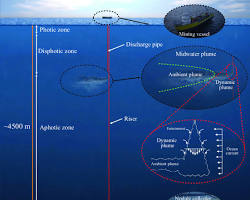
The diagram shows a deep-sea drilling rig used to extract minerals from the ocean floor.

Japan is home to some of the world's leading deepwater mining companies, including Japan National Oil, Gas and Metals Corporation (JOGMEC). JOGMEC has been involved in deep-sea exploration for more than 20 years and is currently developing a pilot project to extract rare earth metals from the seabed.

The Japanese government also supports the development of deepwater mining technologies through the Ministry of Economy, Trade and Industry (METI). METI has launched a number of initiatives to promote deepwater mining, including the establishment of a research center and the provision of funding for research projects.

Before deep-sea mining becomes a reality, a number of problems must be solved. One of the biggest problems is the environmental impact of deep-sea mining. The mining process has the potential to harm the marine environment and there is a risk of .

Another issue is the cost of deepwater mining. The technology is still in the early stages of development, and operating mining equipment at depths of thousands of meters is expensive.

Despite the difficulties, Japan is determined to develop deep-sea mining technologies. The country believes that deep-sea mining is essential to ensure future supplies of essential minerals and reduce dependence on imports. The Japanese government is also committed to minimizing the environmental impact of deep-sea mining.

Learn more about deep sea mining
Join the debate on deep-sea mining
To support the development of sustainable deep-sea mining technologies

Comments

IN TREND

NASA’s Webb Uncovers Methane on Interstellar Comet 3I/ATLAS: A Cosmic Breakthrough

Imagine looking up at the night sky and realizing that the tiny, distant glimmer you see isn't just a remnant of our own cosmic neighborhood, but a visitor from a completely different solar system. The universe is whispering secrets to us, and for the first time in human history, we have the ears to listen. The James Webb Space Telescope (JWST) has just shattered our understanding of interstellar travelers by detecting methane on the comet 3I/ATLAS. This isn't just a chemical reading; it is a profound connection to the unknown, a bridge built of stardust and science that links our home to the mysterious voids between stars. The Arrival of an Interstellar Messenger For decades, astronomers dreamed of catching a glimpse of an object originating from outside our solar system. In 2017, we met 'Oumuamua, and later, 2I/Borisov. However, the discovery of 3I/ATLAS —often referred to as an interstellar comet—has provided us with a laboratory like no other. When this icy wanderer...

Unearthing the Secrets of Notre-Dame: The Archaeological Discovery of the Century

Imagine standing in the heart of Paris, surrounded by the echoes of modernity—the honking of taxis, the bustle of tourists, and the vibrant hum of a 21st-century metropolis. Now, imagine peeling back the layers of time, descending deep into the cool, silent earth beneath the scarred but resilient frame of Notre-Dame Cathedral. What lies beneath is not merely dirt and stone; it is a time capsule, a bridge across millennia, and quite arguably, the most significant archaeological find in modern French history. When the catastrophic fire of 2019 ravaged the cathedral, the world watched in heartbreak. But from the ashes, a new narrative emerged. As architects and historians prepared to reconstruct the spire, they stumbled upon secrets that had been buried for nearly two millennia. This is the story of the "dig of the century," where ghosts of the past finally meet the light of the present. Who Excavated the Site? The Guardians of History The monumental task of excavating ben...

Green Energy Costs to 2035: Prices & Trends

Green Energy Costs to 2035: Why Solar and Wind May Rise While Batteries Fall The global renewable energy revolution is accelerating. Governments, corporations, and households are investing billions in green energy systems. Yet a paradox is emerging: while the cost of generating solar power and wind energy may increase in the coming decade, battery storage prices are projected to decline significantly. Why is this happening? And what will it mean for consumers and investors by 2035? This evergreen analysis explores the economic forces shaping energy markets, provides price forecasts in U.S. dollars, and explains how global trends could redefine the cost of clean electricity. Why Green Energy Became So Affordable Over the past 15 years, renewable technologies have experienced dramatic cost reductions. According to the International Renewable Energy Agency (IRENA) , global weighted-average costs of solar photovoltaic electricity dropped by nearly 90% between 2010 an...