
Ocean Acidification and CO2: How Electrochemical Technology Can Help

Ocean acidification is a serious threat to the marine environment. This is caused by the absorption of carbon dioxide (CO2) from the atmosphere into the ocean. CO2 reacts with seawater to form carbonic acid, which lowers the pH of the ocean.
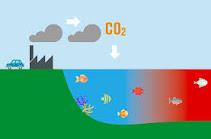
The image shows the cycle of carbon dioxide (CO2) in the atmosphere, ocean and land. Arrows show how CO2 moves between different reservoirs.

This acidification process has a number of negative consequences for marine life, including:

Reducing calcification: Many marine organisms such as corals and molluscs use calcium carbonate to build their shells and skeletons. Acidification makes it harder for these organisms to build and maintain their structures, making them more susceptible to disease and death.
Reproduction disruption: Acidification can also disrupt the reproduction of marine organisms. For example, it can make it difficult for fish to hatch eggs.
Reduced food availability: Acidification can also reduce the availability of food for marine organisms. This is because it can disrupt the growth of phytoplankton, which is the base of the marine food chain.
Electrochemical technology is a promising new approach to combating ocean acidification. This technology uses an electrochemical cell to remove CO2 from seawater. The CO2 is then converted into a form that can be safely stored or used.

How it works

Electrochemical technology works by passing an electric current through seawater. This current causes the CO2 in the seawater to react with the electrodes in the cell, producing a gas that can be collected. The CO2 can then be converted into a form that can be safely stored or used.

What scientists say

Several scientists have explored the potential of electrochemical technology to address ocean acidification. In a 2019 study, a team of scientists from the University of California, Berkeley found that electrochemical technologies can be used to remove CO2 from seawater at a rate of 100 tons per day. Scientists have concluded that electrochemical technology is a "promising approach" to solving the problem of ocean acidification.

Opinions of experts

Experts believe that electrochemical technology can make a significant contribution to the fight against ocean acidification. In a 2020 interview, Dr. Jane Lubchenko, a former NOAA administrator, said that electrochemical technology is "one of the most promising technologies" to combat ocean acidification.

Ocean acidification is a serious threat to the marine environment. Electrochemical technology is a promising new approach to address this threat. This technology has the potential to remove CO2 from seawater on a large scale and is being studied by scientists around the world. Experts believe that electrochemical technology can make a significant contribution to the fight against ocean acidification.

Comments

  1. The use of Electrochemical Analyser technology presents an innovative approach to tackling ocean acidification. By efficiently removing CO2 from seawater, this method offers a sustainable solution to protect marine ecosystems. As scientists continue to explore its potential, electrochemical technology could play a crucial role in preserving ocean health and maintaining biodiversity.

    Also Visit:- https://mpplstandards.com/instrumental-lab/

    ReplyDelete

Post a Comment

IN TREND

Green Energy Costs to 2035: Prices & Trends

Green Energy Costs to 2035: Why Solar and Wind May Rise While Batteries Fall The global renewable energy revolution is accelerating. Governments, corporations, and households are investing billions in green energy systems. Yet a paradox is emerging: while the cost of generating solar power and wind energy may increase in the coming decade, battery storage prices are projected to decline significantly. Why is this happening? And what will it mean for consumers and investors by 2035? This evergreen analysis explores the economic forces shaping energy markets, provides price forecasts in U.S. dollars, and explains how global trends could redefine the cost of clean electricity. Why Green Energy Became So Affordable Over the past 15 years, renewable technologies have experienced dramatic cost reductions. According to the International Renewable Energy Agency (IRENA) , global weighted-average costs of solar photovoltaic electricity dropped by nearly 90% between 2010 an...

NASA’s Webb Uncovers Methane on Interstellar Comet 3I/ATLAS: A Cosmic Breakthrough

Imagine looking up at the night sky and realizing that the tiny, distant glimmer you see isn't just a remnant of our own cosmic neighborhood, but a visitor from a completely different solar system. The universe is whispering secrets to us, and for the first time in human history, we have the ears to listen. The James Webb Space Telescope (JWST) has just shattered our understanding of interstellar travelers by detecting methane on the comet 3I/ATLAS. This isn't just a chemical reading; it is a profound connection to the unknown, a bridge built of stardust and science that links our home to the mysterious voids between stars. The Arrival of an Interstellar Messenger For decades, astronomers dreamed of catching a glimpse of an object originating from outside our solar system. In 2017, we met 'Oumuamua, and later, 2I/Borisov. However, the discovery of 3I/ATLAS —often referred to as an interstellar comet—has provided us with a laboratory like no other. When this icy wanderer...

Unearthing the Secrets of Notre-Dame: The Archaeological Discovery of the Century

Imagine standing in the heart of Paris, surrounded by the echoes of modernity—the honking of taxis, the bustle of tourists, and the vibrant hum of a 21st-century metropolis. Now, imagine peeling back the layers of time, descending deep into the cool, silent earth beneath the scarred but resilient frame of Notre-Dame Cathedral. What lies beneath is not merely dirt and stone; it is a time capsule, a bridge across millennia, and quite arguably, the most significant archaeological find in modern French history. When the catastrophic fire of 2019 ravaged the cathedral, the world watched in heartbreak. But from the ashes, a new narrative emerged. As architects and historians prepared to reconstruct the spire, they stumbled upon secrets that had been buried for nearly two millennia. This is the story of the "dig of the century," where ghosts of the past finally meet the light of the present. Who Excavated the Site? The Guardians of History The monumental task of excavating ben...